
🎬 BLOG 32 — Why Your Characters All Sound the Same (And How to Give Every Voice Its Own Pulse)

Let’s talk about dialogue again, but from a different angle — not how to write it, but how to make it sound like it actually came from different human beings. Because one of the most common problems in early drafts is that every character sounds like the same person wearing different hats. And look, it’s not because you’re a bad writer. It’s because you’re the only person in the room when you’re writing. Of course, your characters start to echo your rhythm, your vocabulary, your emotional patterns. But the danger is that when everyone talks the same, the world of your script collapses into a single voice, and the audience stops believing in the people on the page.
The first reason characters blend together is because the writer is focused on the information instead of the personality. When you’re trying to get the plot across, you start writing dialogue like a conveyor belt — clean, efficient, and completely devoid of flavor. But real people don’t talk like that. They talk with quirks, hesitations, contradictions, and emotional fingerprints. They talk with their history. They talk with their wounds. They talk with their worldview. If your characters are all delivering information the same way, it’s because you’re thinking like a writer instead of thinking like them.
Another reason characters sound the same is because the writer hasn’t fully explored who they are beyond the plot. You might know their job, their age, their backstory, but you haven’t tapped into their inner rhythm. Every person has a rhythm — the speed they talk, the way they dodge questions, the way they joke when they’re uncomfortable, the way they get quiet when they’re hurt. Some people ramble. Some people speak in clipped sentences. Some people intellectualize everything. Some people can’t finish a thought without spiraling into another one. When you find a character’s rhythm, their voice starts to separate from the others naturally.
A lot of writers also fall into the trap of making every character too articulate. It’s tempting to give everyone sharp comebacks, poetic lines, and perfectly timed emotional insights. But that’s not how people talk. Some characters don’t have the words. Some characters avoid the words. Some characters say the wrong thing. Some characters say too much. Some characters say nothing until it’s too late. Imperfection is what makes dialogue feel human. If every character speaks with the same level of polish, the script starts to feel like a staged reading instead of a living story.
Another issue is that writers often forget that characters come from different worlds. A character’s background shapes their vocabulary, their references, their humor, their emotional language. Someone who grew up in a strict household speaks differently than someone who grew up in chaos. Someone who’s been burned by relationships speaks differently than someone who’s never been hurt. Someone who’s used to being ignored speaks differently than someone who’s used to being listened to. When you let their world shape their words, their voice becomes distinct without you having to force it.
Sometimes characters sound the same because the writer is afraid to let them disagree. When everyone is aligned, polite, and emotionally tidy, the dialogue becomes flat and interchangeable. But when characters have different values, different fears, different desires, and different emotional temperatures, their voices naturally diverge. Conflict isn’t just about plot — it’s about personality. Let your characters clash. Let them misunderstand each other. Let them talk past each other. That friction creates individuality.
And here’s the veteran‑writer truth: the best way to give characters unique voices is to spend time with them outside the script. Write a page of them ranting about something they care about. Write a fake text conversation between them and someone from their past. Write a monologue they’d never say out loud. You’re not doing this for the script — you’re doing it to hear them. Once you hear them, you can’t unhear them. Their voice becomes part of your muscle memory.
The final thing to remember is that characters don’t need to be wildly different to feel distinct. They just need to be specific. A character who speaks softly but cuts deep is different from a character who speaks loudly but reveals nothing. A character who jokes to avoid pain is different from a character who jokes to connect. A character who talks too much because they’re anxious is different from a character who talks too much because they love the sound of their own voice. Specificity is the secret sauce. It’s what makes the audience feel like they’re listening to real people instead of puppets.
When your characters each have their own pulse, your script stops feeling like writing and starts feeling like life. And that’s the moment the story becomes cinematic — not because of the plot, but because of the people living inside it.
🎬 BLOG 33 — Why Your Script Feels “Too Predictable” (And How to Create Surprises That Don’t Feel Cheap or Forced)

Let’s talk about predictability — that quiet little assassin that sneaks into your script and drains the life out of it without you even noticing. Predictability isn’t about the audience guessing the ending. Most endings are guessable. The hero wins, the lovers reunite, the villain gets what’s coming. Predictability is about the journey feeling flat. It’s when the audience feels like they’ve walked this road before, with these characters, in this exact order, and nothing surprises them along the way. And the truth is, predictability doesn’t come from lack of imagination. It comes from playing it safe.
One of the biggest reasons scripts feel predictable is because the writer is following structure like it’s a checklist instead of a living organism. You can feel it on the page when a writer is hitting beats because they think they’re supposed to. The inciting incident shows up right on time, the midpoint twist feels like it was installed by a screenwriting software, and the climax arrives exactly when the formula says it should. Structure is important, but when you treat it like a paint‑by‑numbers kit, the audience senses the pattern. They start predicting not because they’re smart, but because the script is obedient. And obedient storytelling is boring.
Another reason scripts feel predictable is because the characters are too consistent. Real people contradict themselves. They make unexpected choices. They surprise you. They say the wrong thing at the wrong time. But a lot of characters in early drafts behave like they’re trying to win “Employee of the Month” in the story. They always act in line with their archetype. The tough guy is always tough. The shy girl is always shy. The villain is always villainous. But the most memorable moments in film come from characters breaking their own patterns. When the quiet character finally snaps. When the confident character cracks. When the villain shows a moment of humanity. Those moments don’t just surprise the audience — they deepen the story.
Predictability also creeps in when the writer is afraid to let things go wrong. You can feel it when a script is too gentle with its characters. Conflicts resolve too quickly. Tension evaporates before it can sting. Characters forgive each other too easily. The story avoids the messy, uncomfortable choices that make drama feel real. But unpredictability comes from letting the characters suffer a little. Letting them make mistakes. Letting them dig holes they can’t climb out of. When the writer stops protecting the characters, the story starts breathing.
Another issue is that writers often rely on familiar emotional beats. The sad moment looks like every sad moment you’ve seen. The romantic moment feels like a recycled rom‑com montage. The argument feels like a scene from a show you’ve watched a hundred times. Predictability isn’t just about plot — it’s about emotional rhythm. If the emotional beats feel familiar, the audience checks out. But when you let emotions unfold in ways that feel specific to these characters, in this moment, with their history, the scene becomes unpredictable because it becomes personal.
Sometimes predictability comes from the writer trying too hard to be clever. Ironically, the more you chase the “unexpected twist,” the more predictable you become. Audiences can smell desperation. They can feel when a twist is there just to shock them. And when a twist isn’t rooted in character or theme, it feels cheap. The best surprises don’t come from left field — they come from the truth. They come from the character making a choice that feels both surprising and inevitable. That’s the sweet spot. That’s where the audience goes, “I didn’t see that coming, but of course they would do that.”
And here’s the veteran‑writer truth: unpredictability isn’t about randomness. It’s about honesty. When you write honestly — when you let the characters react like real people instead of plot devices — the story naturally becomes less predictable. Real people don’t follow formulas. Real emotions don’t follow templates. Real choices don’t follow beat sheets. When you let the story unfold from the inside out instead of the outside in, the audience stops predicting and starts experiencing.
The final thing to remember is that unpredictability doesn’t mean chaos. It doesn’t mean throwing curveballs just to keep the audience guessing. It means creating a story where the characters are alive enough to surprise you. If they surprise you, they’ll surprise the audience. And when the audience feels that spark — that moment where the story takes a turn they didn’t expect but instantly believe — that’s when your script stops being predictable and starts being unforgettable.
🎬 BLOG 34 — Why Your Script Feels “Emotionally Thin” (And How to Build Real Depth Without Getting Melodramatic)

Let’s talk about emotional depth — not the big crying scenes, not the dramatic confrontations, not the Oscar‑clip moments. I mean the quiet emotional weight that makes a script feel lived‑in, human, and resonant. A lot of scripts have plot. A lot of scripts have structure. A lot of scripts even have interesting characters. But emotional depth is the thing that separates a script that’s technically solid from a script that actually hits the audience somewhere real. And the truth is, emotional thinness usually isn’t about what’s missing on the page — it’s about what the writer hasn’t fully confronted in themselves.
One of the biggest reasons scripts feel emotionally thin is because the writer is afraid to let characters feel anything too deeply. You can sense it when a script keeps everything at arm’s length. Characters talk about their problems instead of experiencing them. They intellectualize instead of breaking. They joke instead of revealing. They move through the story like they’re trying not to make a mess. But emotional depth requires mess. It requires letting characters sit in discomfort, confusion, longing, shame, desire — all the things we try to avoid in real life. When a writer avoids those emotions, the script becomes emotionally polite, and polite stories rarely linger.
Another reason scripts feel thin is because the emotional beats aren’t connected to the character’s internal journey. You can have a beautifully written sad scene, but if it doesn’t grow out of the character’s wound, it feels like decoration instead of story. Emotional depth comes from understanding what your character is carrying — the thing they don’t talk about, the thing they don’t want to face, the thing that shapes every choice they make. When the emotional moments are rooted in that wound, they feel inevitable. When they’re not, they feel like the writer is trying to manipulate the audience.
A lot of emotional thinness also comes from rushing through the moments that matter. Writers sometimes treat emotional beats like checkpoints — hit it, move on, keep the plot moving. But emotion needs space. It needs breath. It needs silence. It needs the moment after the moment. The audience wants to feel the weight of what just happened, not sprint past it. When you give emotional beats room to land, the story deepens without you having to add anything flashy.
Sometimes scripts feel emotionally thin because the writer is afraid of melodrama, so they overcorrect. They strip out vulnerability. They avoid big feelings. They keep everything subtle to the point of invisibility. But emotional depth isn’t melodrama. Melodrama is emotion without truth. Emotional depth is truth without fear. It’s not about making characters cry — it’s about making them honest. And honesty can be quiet, restrained, even understated, as long as it’s real.
Another issue is that writers often forget that emotional depth comes from relationships, not monologues. A character alone in a room thinking about their feelings is rarely compelling. But a character trying to hide their feelings from someone they care about? That’s where the electricity is. Emotional depth comes from the friction between people — the things they want to say but can’t, the things they say but don’t mean, the things they reveal by accident, the things they protect at all costs. When relationships are alive, the emotional world of the script expands.
And here’s the veteran‑writer truth: emotional depth requires the writer to be vulnerable. You can’t fake it. You can’t manufacture it. You can’t trick the audience into feeling something you didn’t feel while writing it. The scenes that hit hardest are the ones where the writer put a piece of themselves on the page — a fear, a memory, a regret, a longing, a truth they didn’t want to admit. When you write from that place, the script stops being emotionally thin because it stops being emotionally safe.
The final thing to remember is that emotional depth doesn’t come from adding more emotion. It comes from adding more humanity. When your characters feel like real people — flawed, scared, hopeful, contradictory, trying their best and failing anyway — the audience connects. And once the audience connects, even the smallest emotional moment can hit like a punch. Emotional depth isn’t about volume. It’s about honesty. And when you write honestly, your script stops being thin and starts being something that stays with people long after the final scene.
🎬 BLOG 35 — Why Your Script Lacks a Strong Theme (And Why That Makes Everything Feel Unfocused, Even If the Plot Is Solid)

Let’s talk about theme — the thing writers either obsess over too early or ignore until the last possible second. Theme is one of those concepts that sounds abstract, academic, even pretentious, but in reality it’s the emotional backbone of your story. It’s the quiet pulse underneath every scene. It’s the reason the story exists beyond entertainment. And when a script doesn’t have a strong theme, you can feel it immediately. The plot might be tight. The characters might be interesting. The dialogue might be sharp. But the whole thing feels like it’s missing a center, like it’s wandering without purpose. That’s what happens when the story doesn’t know what it’s trying to say.
A lot of writers avoid theme because they think it means preaching. They’re terrified of writing something that feels like a message movie or a lecture disguised as a screenplay. But theme isn’t a message. Theme is a question. It’s the question your story is wrestling with, the question your protagonist is forced to confront, the question the audience feels echoing long after the credits roll. When writers think theme means “I must teach the audience something,” they shut down their own creativity. But when they realize theme simply means “I’m exploring something that matters to me,” the story opens up.
Another reason scripts lack strong themes is because the writer hasn’t dug deep enough into the protagonist’s internal struggle. Theme isn’t something you sprinkle on top of the plot. It grows out of the character’s wound, their flaw, their fear, their longing. If your protagonist is just trying to accomplish a goal without confronting anything inside themselves, the story feels hollow. But when the protagonist’s internal journey mirrors the thematic question — when their choices, mistakes, and breakthroughs all orbit the same emotional truth — the script suddenly feels cohesive. Everything starts pointing in the same direction.
Sometimes scripts feel thematically weak because the writer is juggling too many ideas at once. They want the story to be about trauma, and forgiveness, and identity, and family, and redemption, and social commentary, and the meaning of life. But theme isn’t a buffet. It’s a spine. When you try to explore everything, you end up exploring nothing. The audience doesn’t know what to hold onto. The story feels scattered. But when you commit to one central thematic question — even if it has layers — the script becomes sharper, clearer, more emotionally focused.
Another issue is that writers often try to force theme into the dialogue. Characters start saying things like “Sometimes you have to let go” or “We all have to face our fears” or “Love is the only thing that matters.” And look, there’s nothing wrong with a character expressing something meaningful. But when theme is delivered through on‑the‑nose dialogue, it feels artificial. Theme should be felt, not announced. It should emerge from the character’s choices, not their speeches. When theme is woven into the story’s DNA instead of pasted onto the dialogue, it resonates more deeply.
And here’s the veteran‑writer truth: theme isn’t something you always know when you start writing. Sometimes you discover it halfway through the draft. Sometimes you don’t see it until the rewrite. Sometimes it reveals itself in a scene you didn’t expect to write. That’s normal. That’s part of the process. The mistake is pretending you know the theme before the story has shown you what it wants to be. The best themes aren’t imposed — they’re uncovered. They’re the emotional truth hiding underneath the plot, waiting for you to notice it.
The final thing to remember is that theme gives your story weight. It’s what makes the audience feel like the story meant something. It’s what makes the ending land. It’s what makes the characters feel real. It’s what makes the script linger in someone’s mind after they put it down. A strong theme doesn’t make your story preachy — it makes your story human. And when your story has a heartbeat, everything else — the plot, the characters, the dialogue — suddenly feels more alive.
🎬 BLOG 36 — Why Your Script Feels “Visually Bland” (And How to Write Images That Actually Play Like Cinema)

Let’s talk about visual storytelling — not the flashy stuff, not the big set pieces, not the “this will look great in the trailer” moments. I mean the everyday visual language of your script, the way you paint the world, the way you guide the reader’s eye, the way you make the story feel like a movie instead of a radio play. A lot of scripts feel visually bland not because the writer lacks imagination, but because they’re writing scenes as conversations instead of experiences. They’re writing what happens, not what it feels like. And cinema is all about feeling.
One of the biggest reasons scripts feel visually flat is because the writer relies too heavily on dialogue to carry the emotional weight. When characters talk through every beat, every conflict, every revelation, the script starts to feel like a stage play. But film is a visual medium. The audience wants to see the emotion, not hear it explained. A character sitting alone in a quiet room can say more with a single gesture than with a page of dialogue. When you let the visuals speak, the story gains texture, atmosphere, and emotional resonance.
Another reason scripts feel bland is because the writer describes locations like they’re filling out a real estate listing. “A small apartment. A busy street. A dimly lit bar.” These descriptions tell us nothing about the world. They don’t create mood. They don’t reveal character. They don’t give the scene a pulse. A location isn’t just a place — it’s an emotional environment. The way a room is lit, the way objects are arranged, the way the air feels — all of that shapes the scene. When you describe a location with intention, the world becomes part of the storytelling instead of just a backdrop.
A lot of writers also forget that visuals aren’t just about what you show — they’re about what you choose not to show. Restraint is powerful. Suggestion is powerful. A shadow can be more unsettling than a monster. A half‑open door can be more intriguing than a full reveal. A character’s reaction can be more emotional than the event itself. When you let the audience fill in the blanks, the visuals become more personal, more intimate, more cinematic. Over‑explaining kills mystery. Under‑explaining invites imagination.
Sometimes scripts feel visually bland because the writer isn’t thinking in moments. They’re thinking in beats, in plot points, in dialogue exchanges. But cinema is built on moments — the small, specific, emotionally charged images that linger in the audience’s mind. A hand trembling over a doorknob. A character staring at a photograph they can’t throw away. A streetlight flickering at the exact wrong moment. These moments don’t need to be big. They just need to be intentional. When you write with an eye for moments, the script starts to breathe visually.
Another issue is that writers often describe action in a way that feels mechanical. “He walks. She sits. He opens the door. She looks at him.” These are instructions, not storytelling. Action should reveal character. The way someone walks into a room tells you everything about their emotional state. The way someone pours a drink tells you everything about their nerves. The way someone avoids eye contact tells you everything about their guilt. When you write action with emotional subtext, the visuals become alive.
And here’s the veteran‑writer truth: you don’t need to write like a cinematographer. You don’t need to call shots. You don’t need to choreograph the camera. You just need to write images that feel like they belong on a screen. Images that carry emotion. Images that reveal character. Images that move the story forward. When you focus on the emotional purpose of the visual, the cinematic quality emerges naturally.
The final thing to remember is that visual storytelling isn’t about being fancy. It’s about being specific. A single well‑chosen detail can transform a scene. A single image can define a character. A single moment can elevate the entire script. When you write visually with intention, your script stops feeling like words on a page and starts feeling like a film waiting to happen. And that’s when the reader stops reading and starts watching.
🎬 BLOG 37 — Why Your Script Feels “Overwritten” (And How to Strip Away the Fat Without Losing the Soul)

Let’s talk about overwriting — the silent weight that drags a script down without ever announcing itself. Overwriting isn’t about writing too much. It’s about writing more than the story needs. It’s the instinct to explain instead of imply, to describe instead of suggest, to fill the silence instead of trusting it. And the truth is, overwriting doesn’t come from lack of skill. It comes from fear. Fear that the reader won’t understand. Fear that the emotion won’t land. Fear that the scene won’t be clear. Fear that the script won’t be “enough.” But the irony is that overwriting is what makes a script feel heavy, slow, and unfocused.
One of the biggest reasons scripts feel overwritten is because the writer is trying to control the reader’s experience too tightly. You can feel it when every line of action is packed with adjectives, metaphors, and emotional commentary. The writer is trying to force the reader to see the scene exactly as they imagine it, down to the smallest detail. But film is a collaborative medium. The director, the actors, the cinematographer — they all bring their own interpretation. When you over‑describe, you suffocate the space where creativity lives. The best scripts guide the reader, not cage them.
Another reason overwriting happens is because the writer doesn’t trust subtext. They feel the need to spell out every emotion, every intention, every internal shift. But the audience doesn’t need to be told what a character feels — they need to be shown. A character staring at a closed door can say more than a paragraph explaining their heartbreak. A character hesitating before answering a question can reveal more than a monologue about their fear. When you let the audience participate in the emotional experience, the script becomes more powerful, not less.
Sometimes overwriting shows up in dialogue. Characters speak in long, polished speeches that sound beautiful but don’t feel human. They explain their motivations, their backstory, their worldview, all in one breath. But real people rarely articulate themselves so cleanly. They stumble. They dodge. They contradict themselves. They say the wrong thing. They say too little. When dialogue becomes too perfect, it stops feeling like conversation and starts feeling like performance. And performance kills authenticity.
Overwriting also creeps in when the writer is trying too hard to impress. You can feel it when the prose becomes self‑conscious — when the writer is reaching for poetic language, clever phrasing, or stylistic flourishes that draw attention to the writing instead of the story. There’s nothing wrong with having a voice. Voice is essential. But voice should serve the story, not overshadow it. When the writing becomes the star, the characters fade into the background.
Another issue is that writers often overwrite because they’re trying to solve structural problems with more words. If a scene isn’t working, they add more explanation. If a character’s motivation isn’t clear, they add more dialogue. If the pacing feels slow, they add more action lines. But overwriting is a symptom, not a cure. The real solution is to fix the underlying issue — the unclear goal, the weak conflict, the missing tension. When the foundation is strong, the writing can be lean. When the foundation is shaky, the writing becomes bloated.
And here’s the veteran‑writer truth: the cure for overwriting isn’t cutting words. It’s clarifying intention. When you know exactly what the scene is about — the emotional shift, the power dynamic, the turning point — you naturally write with precision. You stop wandering. You stop padding. You stop explaining. You start trusting the story. And when you trust the story, the writing becomes cleaner, sharper, more confident.
The final thing to remember is that great writing isn’t about saying everything. It’s about saying the right things. The space between the lines is where the audience breathes. The silence is where the emotion settles. The restraint is where the power lives. When you strip away the excess, what remains is the truth — and truth is what makes a script unforgettable.
🎬 BLOG 38 — Film Tax Credits Explained

Film Tax Credits Explained: What They Are, How They Work, and Why Filmmakers Rely on Them
If you’ve spent more than five minutes around indie producers, you’ve heard the phrase “We’re shooting there because of the tax credit.” It gets tossed around like everyone automatically understands it — but most filmmakers never get a clear, human explanation of what film tax credits actually are or how they function inside a real production budget. So let’s break it down the way a seasoned producer would explain it over coffee, not the way a state website would bury it in legalese.
At the simplest level, a film tax credit is a financial incentive offered by a state or country to attract film productions. Governments want the jobs, tourism, and economic activity that film crews bring, so they essentially say, “If you spend money here, we’ll give you a percentage of it back.” That percentage varies wildly — some places offer 20%, others 30–40%, and a few regions go even higher when you hire local crew or shoot in rural areas. The key idea is that the government is rewarding you for spending money in their backyard.
Now, here’s where filmmakers get confused: a tax credit is not the same thing as a tax rebate. A rebate is a direct cash refund — you spend money, you get money back. A tax credit, on the other hand, reduces your tax liability. But many states make their credits refundable or transferable, which is why producers still treat them like cash. A refundable credit means the state cuts you a check even if you owe zero taxes. A transferable credit means you can sell it to a local business that does owe taxes, usually at a slight discount. Either way, it becomes real money you can plug into your financing plan.
This is why tax credits are often considered “soft money.” They’re not guaranteed until you follow the rules, but once you do, they become a predictable chunk of your budget. A $1 million film shooting in a 30% credit state can realistically expect around $300,000 back — which is massive for an indie production. That money can cover post‑production, extend your shooting schedule, or reduce the amount you need from investors. And investors love tax credits because they lower risk. If you can tell someone, “A third of your investment is essentially guaranteed to return through the credit,” that’s a much easier pitch.
Of course, there’s always fine print. Every region has its own rules about what qualifies. Some only count in‑state labor. Some require you to hire a certain percentage of local crew. Some demand that you spend a minimum amount, or that you submit budgets, call sheets, payroll reports, and receipts down to the last sandwich. It’s paperwork‑heavy, but it’s also free money — and free money rarely comes without a little bureaucracy.
The real trick is timing. Tax credits don’t arrive during production; they usually come months after wrap, sometimes even a year later. That means you either need enough cash flow to wait for the credit, or you work with a lender who fronts you the money in exchange for the future payout. This is called “credit lending,” and it’s extremely common on indie films. It’s also why producers spend so much time talking to accountants, auditors, and state film offices — the smoother the paperwork, the faster the credit arrives.
At the end of the day, film tax credits are one of the most powerful tools in modern independent filmmaking. They stretch budgets, attract investors, and make ambitious projects possible in places that want to support the arts. Once you understand how they work, you start to see why entire productions uproot themselves to chase the best incentives. It’s not just about scenery — it’s about survival.
🎬 BLOG 39 — Best Movie‑Making Cameras Under $2,000 for the Film Industry

There’s a sweet spot in camera gear where price meets performance — that magical zone under $2,000 where indie filmmakers can capture truly cinematic images without mortgaging their future. These aren’t entry‑level toys; they’re serious tools used by professionals who know how to stretch a dollar and still deliver film‑quality visuals. Let’s talk about the cameras that actually matter in that range — the ones that can handle real‑world production demands.
The Panasonic Lumix S5 II is the current indie darling. It’s a full‑frame hybrid camera that shoots 6K video, offers 10‑bit 4:2:2 internal recording, and includes Panasonic’s legendary V‑Log color profile. The dual native ISO makes it a beast in low light, and the in‑body stabilization means handheld shots look smooth enough to pass for gimbal work. For filmmakers who want cinematic color and flexibility in post, the S5 II punches way above its price tag.
Then there’s the Sony Alpha 6700, a compact powerhouse built for creators who move fast. It uses the same processor as Sony’s flagship A7R V, shoots 4K 120p slow‑motion, and has real‑time Eye AF that locks onto subjects like a magnet. It’s perfect for documentary shooters, travel filmmakers, and anyone who needs a lightweight rig that still delivers cinematic depth. Pair it with Sony’s 35 mm f/1.8 lens and you’ve got a setup that looks far more expensive than it is.
The Canon EOS R8 brings full‑frame filmmaking to a smaller body. It captures uncropped 4K 60p footage with Canon’s signature color science — warm, natural skin tones and rich contrast that make grading a breeze. It’s ideal for narrative filmmakers who want that “big‑sensor look” without the bulk or price of the R6 II. The autofocus is fast, reliable, and intuitive, which makes solo shooting far less stressful.
For those who still love the tactile feel of a DSLR, the Nikon Z6 II remains a solid choice. It’s full‑frame, records 10‑bit N‑Log externally, and has a cinematic roll‑off that feels organic. It’s heavier than mirrorless options, but that weight gives handheld shots a natural steadiness. Many indie cinematographers still use it for short films and music videos because it delivers a classic, filmic texture.
And if you’re just starting out, the Canon EOS RP is the most affordable full‑frame option on the list. It’s not built for high‑speed production, but it delivers beautiful color and depth for under $1,100. It’s a great way to learn the language of full‑frame cinematography before upgrading to a more advanced body.
The truth is, the best camera under $2,000 isn’t about specs — it’s about how it fits your workflow. The Lumix S5 II gives you cinematic color and pro‑grade codecs. The Sony A6700 gives you speed and portability. The Canon R8 gives you full‑frame depth and reliability. Each one can shoot a feature film if you know how to light, frame, and tell a story. That’s the real secret: the camera doesn’t make the movie — the filmmaker does.
🎬 BLOG 40 — How Streaming Platforms Pay Filmmakers: The Real Economics Behind the Stream

If you’ve ever tried to decode how Netflix, Amazon, or Tubi actually pay filmmakers, you know it’s not as simple as “upload your movie and get a check.” The streaming economy looks sleek on the surface — endless titles, global reach, instant access — but underneath, it’s a maze of licensing deals, revenue splits, and algorithms that decide who gets paid and how much. Let’s break down the real mechanics, the way producers talk about it behind closed doors.
🎬 1. The Big Three Models: SVOD, TVOD, and AVOD
Every streaming platform falls into one of three categories — Subscription Video on Demand (SVOD), Transactional Video on Demand (TVOD), or Ad‑Supported Video on Demand (AVOD).
- SVOD platforms like Netflix, Hulu, and Max pay filmmakers through licensing fees. They buy the rights to stream your film for a set period — usually 12 to 36 months — and pay a flat fee upfront. That fee depends on your film’s perceived value: cast, genre, awards, and audience potential. Once they pay, they own the streaming rights for that window, and you don’t earn per view. It’s clean, predictable, and often the goal for producers who want guaranteed revenue.
- TVOD platforms like iTunes, Google Play, and Amazon Rentals work on a revenue‑share model. Viewers pay per rental or purchase, and the filmmaker typically receives 70–85 percent of that transaction. It’s higher‑risk, higher‑reward — you earn more per view, but only if you can drive traffic. Marketing matters here; without it, your film can vanish into the algorithmic abyss.
- AVOD platforms like Tubi, Pluto TV, and Freevee pay through ad revenue sharing. You don’t charge viewers; instead, you earn a fraction of the ad income generated during your film’s streams — usually $0.005–$0.015 per view. It sounds small, but AVOD’s massive audience reach can make up for it. For indie filmmakers, it’s often the easiest entry point into streaming because there’s no paywall.
💰 2. The Hybrid Era: Mixing Models for Survival
By 2026, the streaming landscape has shifted toward hybrid monetization. Platforms like Amazon Prime Video and Apple TV+ combine subscription and transactional tiers, giving filmmakers multiple revenue streams. A film might earn a licensing fee for inclusion in the subscription catalog, plus additional TVOD income from rentals. This hybrid approach reflects the industry’s new reality — filmmakers can’t rely on one model anymore; they have to stack revenue sources like building blocks.
🧾 3. What Determines Your Paycheck
Your payout depends on three main factors:
- Deal Type — Flat license vs. revenue share.
- Territory — U.S. and Western Europe pay more per view than Latin America or Southeast Asia.
- Performance — Algorithms reward engagement. If viewers finish your film, recommend it, or rewatch it, platforms notice — and that can influence renewal offers or bonus payments.
For SVOD deals, the negotiation is everything. Streamers pay more for exclusivity, genre appeal, and recognizable talent. For AVOD and TVOD, your marketing and metadata matter — title, thumbnail, and description can literally change your earnings.
🎥 4. The Indie Reality Check
Independent filmmakers often work through aggregators or distributors who handle delivery and reporting. These middlemen take a cut — usually 10–20 percent — but they also open doors to major platforms that don’t accept direct submissions. The trade‑off is transparency: you might not see detailed view counts, only quarterly revenue summaries. It’s frustrating, but it’s the cost of entry into the streaming ecosystem.
🌍 5. The Future: FAST Channels and Direct Monetization
The fastest‑growing segment right now is FAST (Free Ad‑Supported Streaming TV) — think curated channels on Tubi or Roku that play films continuously like old‑school cable. Filmmakers earn ad revenue based on watch time and placement frequency. It’s not glamorous, but it’s steady. Meanwhile, some creators are moving toward direct monetization — hosting films on their own sites or platforms like Patreon or Vimeo OTT, where they control pricing and audience data.
🎬 Final Take
Streaming platforms don’t pay filmmakers in one neat way — they pay through a web of deals, tiers, and algorithms. The smartest producers treat streaming like a portfolio: a mix of SVOD stability, TVOD upside, and AVOD reach. The goal isn’t just exposure; it’s sustainability. In 2026, the filmmakers who thrive aren’t chasing one big sale — they’re building long‑term digital ecosystems that keep paying long after the premiere.
Best Microphones for Indie Films: What Filmmakers Really Use on Set

Sound is the one department indie filmmakers underestimate until it ruins a take. You can cheat lighting, you can fix color, you can stabilize shaky footage — but bad audio? That’s the one thing audiences never forgive. The good news is that you don’t need a Hollywood budget to capture clean, cinematic sound. You just need the right microphone for the right situation. Here’s a deep dive into the mics that indie filmmakers actually trust on real sets.
1. Shotgun Microphones — The Workhorses of Indie Film
If you can only afford one microphone, make it a shotgun. These long, directional mics are designed to isolate dialogue and reject background noise, which is essential when you’re shooting in apartments, streets, or locations you don’t control.
The Sennheiser MKE 600 is the go‑to for indie crews because it delivers that classic Sennheiser clarity without the price tag of the legendary MKH‑416. It handles outdoor shoots well, cuts through ambient noise, and pairs beautifully with a boom pole. For filmmakers who want a slightly warmer tone, the RØDE NTG‑3 is another favorite — rugged, weather‑resistant, and surprisingly cinematic for the price.
Shotguns are your “dialogue from a distance” tools. They’re what you boom above actors, hide just out of frame, and rely on when you need clean, natural‑sounding speech.
2. Lavalier Microphones — The Secret Weapon for Clean Dialogue
Lav mics are tiny, clip‑on microphones that capture dialogue up close. They’re lifesavers when you can’t boom a scene — wide shots, walk‑and‑talks, car interiors, or noisy environments where you need the mic practically on the actor’s chest.
The Sanken COS‑11D is the industry standard for a reason. It’s small, durable, and delivers crisp, broadcast‑quality sound. If you’re working with wireless systems, it integrates seamlessly with most transmitters. For budget‑conscious filmmakers, the RØDE Lavalier II offers shockingly good clarity and a low profile that hides well under clothing.
Lavaliers shine when you need consistency. They’re not as cinematic as a shotgun, but they’re reliable — and reliability is everything on set.
3. Wireless Systems — Freedom for Actors, Control for You
Wireless audio used to be a luxury. Now it’s practically required. Modern indie sets rely on wireless systems to keep actors mobile and avoid the nightmare of tangled cables.
The Sennheiser G4 Wireless System is the gold standard for indie productions. It’s stable, clean, and built to survive the chaos of location shooting. If you want something more compact, the RØDE Wireless PRO has become a favorite for run‑and‑gun filmmakers — dual‑channel recording, onboard backup audio, and a tiny footprint that disappears on set.
Wireless systems give you flexibility. They let actors move naturally, they keep your boom operator sane, and they ensure you always have a clean backup track.
4. On‑Camera Microphones — For B‑Roll, Docs, and Guerrilla Shoots
On‑camera mics aren’t meant to replace a boom or lav, but they’re essential for documentary work, travel filmmaking, and quick setups where you don’t have time to rig a full sound team.
The RØDE VideoMic NTG is the standout here — lightweight, directional, and clean enough to use as a primary mic in a pinch. It’s perfect for handheld sequences, behind‑the‑scenes footage, or any moment where mobility matters more than perfection.
Think of on‑camera mics as your “always rolling” safety net. They capture the world around you without slowing you down.
5. Recorder‑Based Microphones — When You Need Independent Audio
Sometimes you need a mic that records directly to its own device — no cables, no transmitters, no fuss. This is where recorder‑based mics shine.
The Zoom H1n is the indie classic: small, reliable, and perfect for plant‑miking in cars, hiding in props, or capturing ambient sound. For higher‑end productions, the Tascam DR‑10L Pro combines a lav mic with a built‑in recorder, giving you clean, isolated audio without worrying about wireless interference.
These mics are your “set it and forget it” tools — perfect for tricky setups where traditional miking isn’t possible.
6. Ambience and Foley Mics — The Texture of Your Film
Great sound isn’t just dialogue. It’s the world around your characters. Ambience, footsteps, room tone — these details make your film feel alive.
The Zoom H5 and H6 are the workhorses of indie ambience recording. They’re portable, modular, and capture rich stereo sound that layers beautifully under dialogue. For Foley or close‑up texture work, a small diaphragm condenser like the Audio‑Technica AT2021 gives you crisp detail without breaking the bank.
These mics are the difference between “good enough” and “cinematic.”
Final Take: Build Your Sound Kit Like a Filmmaker, Not a Shopper
The best microphone for indie film isn’t about price — it’s about purpose.
- Shotgun for cinematic dialogue
- Lav for consistency and mobility
- Wireless for freedom
- On‑camera for speed
- Recorders for problem‑solving
- Ambience mics for world‑building
A great sound kit is a toolbox, not a single purchase. And once you hear clean, rich audio in your edit timeline, you’ll wonder how you ever shot without it.
How to Record Good Sound on a Budget
Every filmmaker learns the hard way that bad sound kills good visuals. You can shoot on a $10,000 camera, but if your audio sounds like a tin can in a hallway, the audience will bail before the first act. The truth is, great sound doesn’t require a massive budget — it requires strategy, awareness, and a few smart gear choices. Let’s break down how indie filmmakers can capture clean, cinematic audio without breaking the bank.
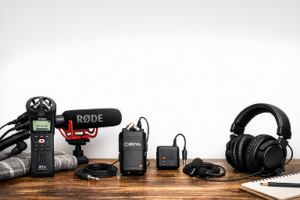
🎙️ Start with the Right Mic — Not the Most Expensive One
The biggest mistake new filmmakers make is assuming price equals quality. It doesn’t. What matters is placement and purpose. A $200 shotgun mic properly boomed will outperform a $1,000 mic mounted on‑camera ten feet away.
If you’re working lean, start with something like the RØDE NTG‑2 or Deity V‑Mic D3 Pro — both deliver crisp, directional sound and handle outdoor shoots well. Pair it with a budget boom pole and a shock mount, and you’ve already elevated your sound above most low‑budget sets. For interiors or dialogue‑heavy scenes, a lav mic like the RØDE Lavalier II or BOYA BY‑M1 Pro can hide under clothing and keep voices clean.
🎧 Use a Recorder That Works for You
Don’t rely on your camera’s preamps — they’re noisy and weak. A dedicated recorder gives you control and clarity. The Zoom H5 or Tascam DR‑40X are indie staples: portable, reliable, and capable of recording multiple tracks. They let you monitor levels, adjust gain, and capture backup audio — all essential when you don’t have a full sound team.
If you’re really scraping by, even a Zoom H1n can do wonders for ambient sound or backup dialogue. The trick is consistency — record clean, monitor constantly, and never assume “it’s fine.”
🧰 DIY Soundproofing and Acoustic Control
You don’t need a studio to control acoustics. Blankets, curtains, and foam mats are your best friends. Hang them around your set to absorb reflections. Throw a rug under your actors to kill floor echo. If you’re shooting in a kitchen or empty room, fill it with soft furniture — anything that breaks up hard surfaces helps.
For exteriors, invest in a deadcat windscreen. It’s a small purchase that saves hours of post‑production cleanup. Wind noise is the silent killer of indie sound.
🎛️ Monitor Everything — Always
Even with cheap gear, monitoring makes the difference. Use closed‑back headphones like the Audio‑Technica ATH‑M40x or Sony MDR‑7506 to catch issues before they ruin a take. Listen for hums, pops, and background chatter. If you can’t hear it on set, you’ll definitely hear it in post.
And don’t forget to record room tone — thirty seconds of silence in every location. It’s the glue that makes your dialogue edits seamless later.
🎬 Post‑Production: The Hidden Budget Saver
Good sound isn’t just captured — it’s sculpted. Free or affordable software like Audacity, DaVinci Resolve Fairlight, or Reaper can clean up noise, balance EQ, and sweeten dialogue. Learn basic audio repair: noise reduction, compression, and EQ shaping. A few hours of practice can turn rough location sound into professional‑grade audio.
If you have a little extra budget, plugins like iZotope RX Elements are worth every penny. They can rescue takes you thought were unusable.
💡 The Indie Philosophy: Control What You Can
Recording good sound on a budget is about control — not perfection. Control your environment, your mic placement, your monitoring, and your post workflow. Every dollar you save can be offset by awareness and preparation. The audience doesn’t care what gear you used; they care that they can hear the story clearly.
So treat sound like a character. Give it space, attention, and respect. Because when your audio feels cinematic, your film instantly feels bigger — no matter how small your budget is.
How Much Movies Make on AVOD vs Rentals: The Real Math Behind Modern Streaming Revenue

Every filmmaker wants to know where the money actually comes from once their film hits streaming. The truth? The difference between AVOD (Ad‑Supported Video on Demand) and TVOD (Transactional Video on Demand, or rentals) isn’t just about audience behavior — it’s about how platforms value your film’s time, attention, and repeatability. Let’s break down what filmmakers really earn from each model in 2026.
🎬 1. The Two Worlds of Digital Monetization
AVOD is the free‑to‑watch model — platforms like Tubi, Pluto TV, and Freevee make money through ads. You earn a share of that ad revenue based on watch time, completion rates, and ad impressions.
TVOD, on the other hand, is the pay‑per‑view model — Apple TV, Google Play, and Amazon Rentals charge viewers per title, and you get a cut of each transaction. It’s direct, clean, and performance‑based.
Both models can coexist in your release strategy, but they pay in radically different ways.
💰 2. What the Numbers Look Like in 2026
According to recent industry analyses, the global AVOD market is worth roughly $49.6 billion in 2026, growing at about 8 percent annually. North America still leads in total ad revenue, while Asia‑Pacific is the fastest‑growing region thanks to mobile‑first viewing and 5G expansion. Mordor Intelligence
For filmmakers, that translates to roughly $0.005–$0.02 per view, depending on the platform, territory, and ad density. A film that racks up a million views might earn $5,000–$20,000 before distributor fees. It’s volume‑driven — the more eyeballs, the better.
By contrast, TVOD rentals typically pay 70–85 percent of the rental price to the rights holder. If your film rents for $3.99, you might see $2.80–$3.40 per transaction. But the catch is scale — far fewer people rent than stream for free. A film that sells 10,000 rentals might earn $30,000, while an AVOD title with 1 million views could make half that. Vitrina
📊 3. Why AVOD Is Growing Faster
Audiences are tired of subscription stacking. They want free access, and advertisers are happy to pay for it. Platforms are now using AI‑driven ad insertion to target viewers more precisely, which increases CPM (cost per thousand impressions) and boosts filmmaker payouts. digitalguruservice.com
For indie films, AVOD offers long‑tail monetization — your movie keeps earning as long as people keep watching. Rentals spike early and fade fast; AVOD builds slowly but steadily.
🧾 4. The Filmmaker’s Cut: What You Actually Take Home
Here’s the sobering part: after distributor fees (10–25 percent), aggregator costs, and taxes, your net AVOD payout might be 60–70 percent of gross ad revenue. TVOD deals are cleaner but still subject to platform fees and payment delays.
In practice, a well‑performing indie film might earn:
- AVOD: $10,000–$25,000 over 12 months
- TVOD: $20,000–$40,000 in the first 3 months
But AVOD keeps paying long after TVOD dries up. It’s the slow burn versus the opening weekend.
🎥 5. The Smart Strategy: Hybrid Distribution
The most successful indie producers in 2026 use hybrid release windows — starting with TVOD for early revenue, then moving to AVOD for long‑term reach. This mirrors the broader “windowing” strategy across theatrical, SVOD, and free streaming. toolsforfilm.com
Think of it like this:
- TVOD = short‑term cash flow
- AVOD = long‑term audience growth
The combination gives you both visibility and sustainability.
🎬 Final Take
Movies don’t make money the way they used to — they make it in layers. Rentals deliver quick returns; AVOD builds residuals. For indie filmmakers, the smartest play is to treat streaming like a portfolio: stack models, diversify platforms, and keep your film alive across multiple windows.
In 2026, the filmmakers who win aren’t chasing one big check — they’re building a steady stream of small ones that never stop flowing.
☁️ Keyphrase Cloud for Blogs
This collection of blogs revolves around the emotional and structural challenges writers face when trying to elevate a script from competent to cinematic. Keyphrases that naturally emerge include:
screenwriting craft, character depth, emotional authenticity, cinematic storytelling, internal conflict, narrative flow, writer vulnerability, thematic clarity, visual writing, subtext-driven dialogue, character voice differentiation, emotional stakes, narrative tension, story momentum, structural cohesion, creative risk-taking, writer honesty, character transformation, scene dynamics, story identity, narrative unpredictability, emotional resonance, cinematic imagery, character-driven storytelling, script refinement, rewriting process, story focus, narrative purpose, character wounds, emotional truth, story cohesion, writer intuition, creative breakthroughs, story clarity, character evolution, narrative pressure, story stakes, emotional weight, script pacing, story rhythm, character contradictions, narrative boldness, and the invisible craft elements that make a script feel alive.
These blogs also emphasize the importance of letting characters be messy, allowing scenes to breathe, trusting subtext, avoiding overwriting, resisting safe choices, and embracing the uncomfortable emotional territory that gives a script its heartbeat.
Phrases like story honesty, emotional depth, cinematic flow, character specificity, narrative risk, thematic spine, visual atmosphere, story authenticity, writer courage, and creative vulnerability all capture the essence of what these pieces are teaching. The overarching cloud reflects a commitment to writing that feels human, alive, unpredictable, emotionally grounded, and visually compelling — the kind of writing that resonates long after the final scene.
screenwriting craft, cinematic storytelling, emotional authenticity, character depth, narrative flow, internal conflict, story momentum, character transformation, thematic clarity, visual writing, subtext-driven dialogue, character voice, emotional stakes, narrative tension, story pacing, script structure, rewriting process, character wounds, emotional truth, story cohesion, narrative purpose, cinematic imagery, character-driven storytelling, story identity, narrative unpredictability, emotional resonance, script refinement, story clarity, character evolution, narrative pressure, story stakes, emotional weight, story rhythm, character contradictions, narrative boldness, creative risk-taking, writer vulnerability, story honesty, visual atmosphere, script pacing, story focus, character specificity, creative breakthroughs, writer intuition, emotional depth, cinematic flow, story authenticity, narrative risk, thematic spine, visual storytelling, character arcs, script development
About the Author